
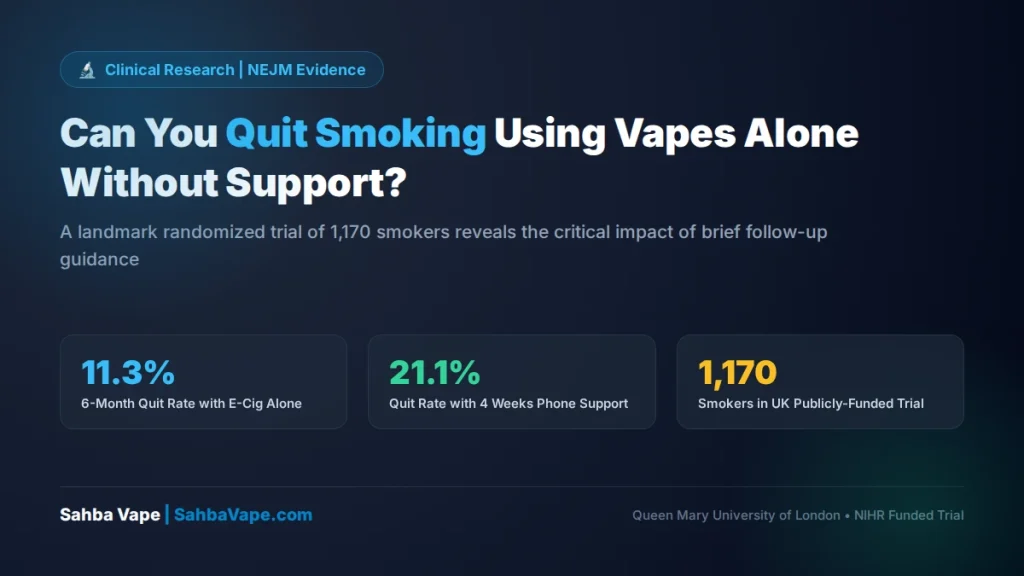
Can You Successfully Quit Smoking Using Vapes Alone Without Support?
According to a major randomized controlled trial conducted in the United Kingdom on 1,170 adult smokers and published in NEJM Evidence, 11.3% of participants who received an e-cigarette kit without any follow-up successfully quit smoking at 6 months, compared to only 2.7% who received motivational text/emails alone. Adding just 4 weeks of brief weekly telephone support surged the quit rate to 21.1% (almost double), demonstrating that e-cigarettes are effective independently, while structured guidance dramatically amplifies long-term success.
For millions of adult smokers worldwide, switching from combustible tobacco to less harmful alternatives begins as a completely self-directed journey. A smoker often steps into a trusted vape shop or browses online, picks up an e-cigarette starter kit or pod system, and embarks on quitting without any medical counseling or formal behavioral support.
Yet a critical clinical question has long persisted among public health researchers: Does an e-cigarette device provide substantial therapeutic cessation efficacy on its own without behavioral support? And exactly how much does brief personal guidance amplify quitting rates?
To address this real-world question, researchers at Queen Mary University of London conducted a landmark trial funded by the UK National Institute for Health and Care Research (NIHR), published in NEJM Evidence. The findings provide definitive, objective evidence for smokers and healthcare policymakers alike.
🔬 Scientific Context: Why Was This Trial Necessary?
The latest Cochrane Systematic Reviews conclude with high certainty that nicotine e-cigarettes are superior to traditional Nicotine Replacement Therapy (NRT, such as nicotine gums and patches). Furthermore, the landmark 2019 UK trial published in the New England Journal of Medicine demonstrated that e-cigarettes coupled with in-person behavioral sessions achieved an 18.0% one-year quit rate versus 9.9% for NRT.
However, nearly all preceding trials paired e-cigarettes with multi-session clinical counseling. In reality, most smokers neither seek nor have access to face-to-face behavioral programs; they prefer self-management. This new trial was specifically engineered to isolate the device’s independent effect and compare it directly against automated digital assistance and brief telephone check-ins.
🎯 Methodology: Evaluating 1,170 Daily Smokers Across Three Arms
The trial enrolled 1,170 adult daily smokers in the UK (smoking an average of 19 cigarettes per day, mean age 48 years, with a high proportion of failed past quit attempts). Participants were randomly assigned to one of three arms:
1. Automated Digital Support
Received daily automated motivational emails for 28 days from the UK National Health Service (NHS) SmokeFree program without any vaping hardware.
2. E-Cigarette Kit Alone
Received an e-cigarette refillable starter kit by mail (battery, tank, coils, and 18 mg/ml e-liquid) with a standard user instruction leaflet, but with zero behavioral follow-up.
3. E-Cigarette + Phone Support
Received the identical e-cigarette kit, plus a telephone call on target quit day and 4 brief weekly telephone check-ins to troubleshoot device setup and offer encouragement.
⚖️ Biochemical Validation: Quitting was defined strictly as sustained continuous abstinence at 6 months, verified objectively by measuring exhaled carbon monoxide (CO < 8 ppm). Participants lost to follow-up were counted as continuing smokers.
📊 Trial Results at 6 and 12 Months (Comparative Data)
| Intervention Group | 6-Month Quit Rate | 12-Month Quit Rate | Statistical Superiority |
|---|---|---|---|
| Automated Email Support Alone | 6.4% (2.7% adjusted*) | 4.2% | Control Arm |
| E-Cigarette Kit Alone (No Support) | 11.3% | 11.4% | 1.76x higher than emails |
| E-Cigarette + 4-Week Phone Support | 21.1% | 16.8% | 1.87x higher than device alone (nearly double!) |
* Statistical adjustment: Researchers discovered that 68% of quitters in the email-only arm bought and used e-cigarettes on their own. When excluding these cross-over vapers, the true quit rate of emails dropped to 2.7%.
💡 Key Clinical Insights: Explaining the Differences
1. E-Cigarettes Possess Intrinsic Cessation Efficacy
The trial confirms that mailing an e-cigarette kit without any interpersonal counseling achieved an 11.3% biochemically verified quit rate at 6 months. In tobacco cessation research, this is a remarkable outcome—outperforming typical unassisted “cold turkey” attempts (approx. 3-5%) and demonstrating that satisfying both the behavioral hand-to-mouth ritual and nicotine cravings offers genuine harm reduction.
2. The Role of Support: Overcoming the Initial Learning Curve
The researchers noted that phone calls did not alter the biochemical action of nicotine; rather, they helped smokers overcome the technical barriers of the critical first 4 weeks. At 4 weeks, 74.2% of smokers in the supported arm were still actively vaping, compared to 63.8% in the unsupported group.
New vapers often struggle with selecting nicotine strength, dealing with coil priming, leaking tanks, or choosing between tight mouth-to-lung (MTL) pod systems and direct-to-lung setups. Getting timely advice—whether from brief phone consultations or knowledgeable staff at a reliable vape shop—prevents early discouragement and premature relapse to combustible cigarettes.
3. Significant Harm Reduction for Partial Quitters
Even among participants who did not completely stop smoking, adopting an e-cigarette substantially reduced their daily cigarette consumption by an average of 8.2 to 9.6 cigarettes per day, meaningfully reducing toxic combustion exposure.
📉 One-Year Trajectory: Relapse Prevention and Nicotine Tapering
Tracking participants to the 12-month mark revealed two key behavioral patterns:
- Relapse Shield: 83% of successful quitters continued using their e-cigarettes at one year. Evidence indicates that continuing to vape protects ex-smokers from succumbing to social cues and stress that trigger cigarette relapse.
- Spontaneous Nicotine Reduction: Users voluntarily tapered their nicotine concentrations down from a median of 12 mg/ml at 4 weeks to 6 mg/ml at 12 months, with 5% completely switching to 0 mg (nicotine-free) e-liquids.
🚀 4 Practical Takeaways for Smokers Looking to Transition
Start with an easy-to-use pod system and appropriate nicotine salt e-liquid that closely replicates the throat hit of a combustible cigarette before exploring complex devices.
Visit an experienced vape shop to get proper advice on coil wattage, maintenance, and the right nicotine strength tailored to your previous smoking habits.
Enlisting the encouragement of a friend, community, or brief check-in nearly doubles your chances of success over solo attempts.
Focus first on completely eliminating combustible smoke. Once smoke-free, you can gradually step down your nicotine strength over several months at your own pace.
📚 Scientific References
-
NEJM Evidence (2024): Dunphy, E., et al. “Randomized Trial of E-Cigarettes with and without Behavioural Support for Smoking Cessation.” NEJM Evidence, Queen Mary University of London & NIHR.
Study Link -
The New England Journal of Medicine (2019): Hajek, P., et al. “A Randomized Trial of E-Cigarettes versus Nicotine-Replacement Therapy.” N Engl J Med 2019; 380:629-637.
Study Link -
Cochrane Database of Systematic Reviews: Hartmann-Boyce, J., et al. “Electronic cigarettes for smoking cessation.” Cochrane Library.
Review Link - UK Department of Health and Social Care & NHS: “Swap to Stop” Public Health Initiative Scheme & Vaping Evidence Updates.

