
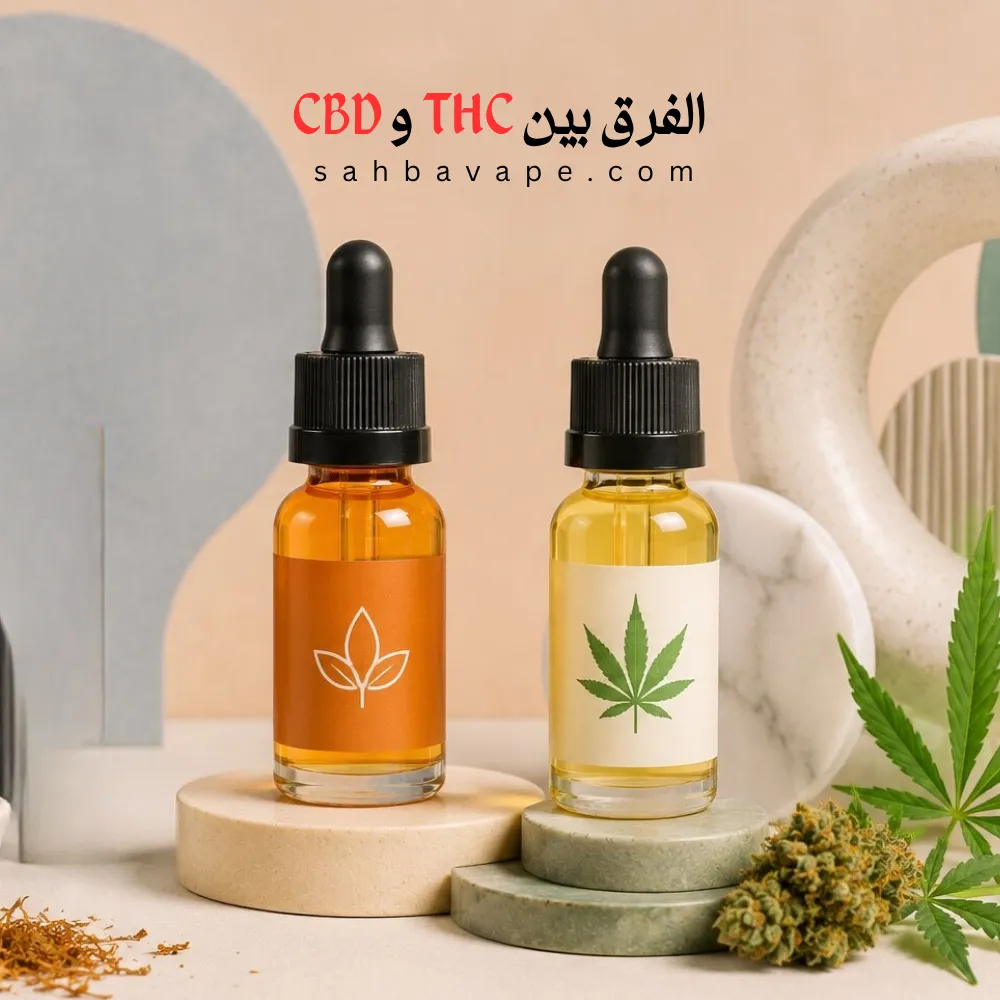
THC and CBD come up constantly on social media and in travel conversations. Some people call CBD “natural and harmless”, others treat the two as the same thing. This guide explains the science behind THC vs CBD, the documented risks of each, and why both are banned in Kuwait with no exceptions — even when the product is labelled “legal” abroad.
What Are THC and CBD?
Both are cannabinoids, compounds produced by the same plant: cannabis. A 2023 review in the journal Neuron calls them “siblings” — they share an origin and much of their structure, yet act on the brain in very different ways.
THC — the compound behind the “high”
Delta-9-tetrahydrocannabinol is the main psychoactive component of cannabis. It binds to and activates CB1 receptors in the brain, which causes euphoria, altered perception and impaired concentration.
CBD — the “quiet” sibling, but not an innocent one
Cannabidiol does not produce a high at typical doses, which is why it is marketed as a “relaxation” product. The research is clear, though, that it is not inactive: it acts on several targets in the brain and changes how the body handles THC and some medications.
THC vs CBD at a Glance
| Factor | THC | CBD |
|---|---|---|
| Source | Cannabis plant | Cannabis plant |
| Effect on CB1 receptor | Activates it (partial agonist) | Modulates it and partly counteracts THC |
| Causes a high? | Yes, even at low doses | Not at typical doses |
| Affects driving and focus? | Yes, well documented | Does not block THC impairment, and can sometimes worsen it |
| Dependence risk | Present and documented | Lower, but long-term safety is unknown |
| Drug interactions | Broken down by liver enzymes CYP2C9 and CYP3A4 | Competes with medications for the CYP3A4 enzyme |
| Legal status in Kuwait | Criminalised | Criminalised |
The Risks of THC According to Research
These are not scare tactics — here are the key findings reported in the Neuron review:
- Dependence: cannabis use disorder was highest among young adults (18–25), at around 16.7% in 2016–2017 surveys.
- Psychosis: daily use of high-THC products increases the risk of developing psychotic disorders.
- Anxiety and panic: high doses can turn “relaxation” into anxiety and schizophrenia-like symptoms.
- Adolescents: early exposure impairs memory and raises anxiety.
- Driving: a cigarette containing 20 mg of THC caused a significant drop in driving stability in trials.
The problem is bigger today than before, because concentrations in modern products — especially vape cartridges and concentrated oils — are far higher than in the traditional plant.
Is CBD Really Safe? Not the Way It Is Marketed
Marketing presents CBD almost like a vitamin. The studies say otherwise:
- Recorded side effects: drowsiness, reduced appetite, diarrhoea and fatigue.
- It does not protect you from THC: at equal doses (125 mg each), CBD did not prevent THC-induced driving impairment — and researchers noted it can sometimes make it worse.
- It prolongs THC’s effects: because it competes for the same liver enzyme, it delays the onset and extends the duration of THC.
- Unknown long-term impact: the author states that we “still do not know” the impact of high-dose CBD on brain development.
- Drug interactions: it is processed by CYP3A4, an enzyme many medications rely on.
There is a more practical danger too: commercial CBD products are not under uniform oversight, so what the label says is not always what is inside — a product can contain THC without you knowing.
THC and CBD Under Kuwaiti Law
There is no grey area here. At the end of 2025 Kuwait issued a new decree-law on combating narcotics and psychotropic substances, merging the two older laws (No. 74 of 1983 and No. 48 of 1987) into a single framework that took effect on 15 December 2025.
What this means for you in practice
- All cannabis derivatives are banned — THC and CBD alike — with no medical or “legal abroad” exception.
- A foreign prescription will not help: bringing CBD oil into Kuwait is prohibited even if you hold a prescription from a country that allows it.
- Shipments get seized: CBD oils, gummies, creams and vape cartridges ordered online are intercepted at customs.
- Trafficking penalties are harsher: up to the death penalty or life imprisonment, with fines from KD 100,000 to KD 2 million.
- The door to treatment is open: the new law grants immunity from prosecution to users who voluntarily come forward for treatment before any case is filed against them.
Bottom line: “CBD is legal” may be true in some countries, but in Kuwait it is exactly the sentence that lands you in front of the public prosecutor.
Vaping: The Legal Option for Adult Smokers
Many people drawn to THC or CBD cartridges are already smokers looking for a different experience from cigarettes. This is where the big difference lies: nicotine vaping products are licensed and sold legally in Kuwait, and they do not put you under the narcotics law.
Why vaping?
- Fully legal for adults, from known sources.
- You know what you are using: a recognised brand of e-liquid with a clearly printed nicotine strength.
- Wide choice: from simple disposables to pod systems and vape mods, with hundreds of flavours from watermelon ice to spearmint.
- You control the strength: salt nicotine or 60 ml e-liquids in different strengths to suit your habits.
One important tip: smuggled THC cartridges look exactly like ordinary vape pods, so never buy a pod or disposable from an unknown social media account. Stick to known brands and licensed shops. If you are new and unsure which type to choose, our disposable vape vs pod system comparison explains the differences in detail and helps you pick a device that suits your style. For an Arabic explainer on how vaping differs from traditional cigarettes, see the difference between pod vapes and cigarettes.
Warning: vaping products contain nicotine, an addictive substance. They are intended for adult smokers (21+) only and are not for non-smokers or pregnant women.
Frequently Asked Questions
What is the difference between THC and CBD in short?
Both come from the cannabis plant. THC activates CB1 receptors in the brain and causes a high and impaired concentration, while CBD does not cause a high at typical doses but still affects the brain and interacts with THC and some medications.
Is CBD oil allowed in Kuwait?
No. All CBD products — oil, gummies, creams or vape cartridges — are banned in Kuwait, and a foreign prescription is not accepted as grounds for bringing them in.
Does CBD reduce the effects of THC?
Partly, in some trials (for example anxiety and paranoia), but it did not prevent driving impairment, sometimes worsened it, and it extends how long THC lasts.
How can I be sure a vape pod contains no THC?
Buy from a licensed shop and a known brand, and check that the pack clearly states the nicotine strength. Avoid any unbranded pod or one from an unknown source.
Conclusion
THC causes a high, dependence and documented mental health risks, and CBD is not the “innocent” product it is marketed as — and above all, both are criminalised in Kuwait under a law that is now stricter than before. If you are an adult smoker looking for a different experience, stick to nicotine vaping from a licensed source: you know exactly what you are using, and you stay on the right side of the law.

